'/%3e%3cdefs%3e%3cpattern%20id='pattern0_2104_4598'%20patternContentUnits='objectBoundingBox'%20width='1'%20height='1'%3e%3cuse%20xlink:href='%23image0_2104_4598'%20transform='matrix(0.00376176%200%200%200.0172414%20-0.00219436%200)'/%3e%3c/pattern%3e%3cimage%20id='image0_2104_4598'%20width='267'%20height='58'%20preserveAspectRatio='none'%20xlink:href='data:image/png;base64,iVBORw0KGgoAAAANSUhEUgAAAQsAAAA6CAMAAACQ2ozcAAAAM1BMVEVMaXH////////////////////////////////////////////////////////////////x7/yuAAAAEHRSTlMAoDDgEPBgwIBAINCwkHBQDIOTDwAAAAlwSFlzAAFxGAABcRgB7MGwCAAABm1JREFUaIHlW+uWsyoMLSIIeH3/pz0CKrmgQuusdn0nf2YaMW42kISgr1cQK+SySj+61/9cmm45RLTfRvNV0WoBIptv4/mi6AWLuiVDd0lKmLPGGPsA0nelGG8TZoXU69poTPi/v1smBjB338dZxvk218B/VIrxBl8hth9t73+Zp2x7SdNuLMX+tJTitZCKjQx1MzFquLBVc+hvpBSv8NMX/Hb+Bv2MbS8DaNsVYn9aSvFK2nWB5slHtr0sUL4Ur0vx+usowdL3A1jBhUVcfGmR1HCBFPbvuWhskvuefC4/wkWbWyMgzV2ub39GarhA+cf0KBevHrTdffSvcuGxonzCA73JBGq4gFnt7qN/lYtxwflEWOA3KWJVriWOpkd0+lUuQj6Rsu6QkcuL9jW2o4xbyzTZfpWLOG79FlatgnP5Y9tRnFn3RAYE7p/loo1bJ6GtnSLIYbuwRrz8rq6SCyY/y8W2UU0SFkw7xQCghszN/y4Xr0ZCKjpPxQz46Vjdj9pupiHUBsxclmRXcOG0CKZHfVV9dHqM1QmRrZNU4IVN15kwQ98fNHSlYNsaUsmmEUw899gNuQCck2ur17KwZXcypM6gsVSCtSN4YcozzLmWqtvbNCPRUDKgbU07RiC/z8XgmOnMtHNiYUJZu8Tbg8YW3B6HOK6PwRPQRo1sT21nBGVq73OxKNaElx8n3iiAR4CL8YbOHlH0YHnXtAL2osg2Gr8PuMgIIaPNTIooqIJdijfkyFO6b6u9gBTDo1M1PKOK6bNcYCBtf9Gwqcc7LHgr1qqFaHil69Y2KAY9zMWe/Ny3BWSU4vVdZ3UtvCHxGuQD7m2nmfY0FyBBGK8bJidXitf/gxbA7DVQwStdBbbVng48zsUxMexdy7EWr/8H9dw/QjJNLRfHKnmci2Pk5G1LW4nX/2U9x5p5eYOLvYj6PBfb+qXHfacWy/H6P6yuhavBfl1Cl0VtK7MaaGcS30wZF6ny2WS4kD71ttjyZgXHEDk5j4Ew2dTh9SbREYCEqA/NBBXY9pHX4E2eLOPiRQT1RsDAv0sc7QZhOHowIwxjHd4wDcDEmCJ1jmjQREG2werBxt3HXKRIwE+cEAYwmMijygze/hxvrq6FNJp0mNp2Zxf0x1ykWD8zLmA7lIChqe+u8U4Eb2goLbjYSaCJdnDqC20jR4JOAMzHXADYjAs4pCj5QYvH3uCFVjy66IR6Y8zoSfDlPr1rhEKdyHCB64GwJ8PHXAA144L3eBcYaw3DixwfW3skqw+GcUpHj1fP60TwSveXXKDRP7fAubjBi2bKwnrAT5p/gAsEEFuA41jNBQ60YZEip8Lq4r/NBexOLRfbvX0XfGZY5i5uVjcNOzs6tz0S23/GhYNctKcWKrmI4Sq+2BlebpRm9FSY8IRYcVTndS3si6DrEX/JBfKdeKjgitcMLw4DxNf7oVcHW/viSLt/kfqV46KHF9BofR5Tr7iA0QKhg6lIJqZe4Q3hExAroJEgIe6c17XgpEOeZy7ighatS7mA0RDlTyiJr8Obr2sJqjmva4H1g7eObREXNEiVcoGeBWqKuXy7FG9kBEhwfyjPZG9wkQOVfJlgS/Bu9+wbyy5z7YoLNL2XfgNMisFTBd6+qH5xW9fqjbV6JLUVfc4FzuS6yVoz3Lyzw7jAi2SlfrWiBTkhaOvwZrnomaa6lrNPxRwX2ft1JRe3Jb40mUvxkmc+Vtcy0NyFjgIv5oJOjEz39nVXitf/Rb6c+4txufQXWTkqpjkuXrnDLlnLhcsfmSU5Up9SvP7ZvK7F4shFXSsrB5lZLrLHXbzGd80FziS4pN15Kd6QXIGJYUhftolyXtfKSgrBWS5c7p6plguyayJyFmcv8IZRT1nmHnKJ5jzvzAoormS5yFoYqrm4AgI//LjFu3cvkKvioLQp2qlIlQseSuEXQYDt7JqFiVmei+wqqeeCfBIFewcT5XK80R+rwZgNx/F60qEhm3Zgu+HHuxK54hMucmTYei5e7B2NCD37hknAy9tDvPS0WjDNef1iTUQMploZvKc942L/3Aj0sXmDi9UOGw0KoQovzAPD2miRhr35mr7fCo3BO0K9pq/ONOBbL03NpIfIcXNQI2gP2gIteym5gSmkGvgbmRd4J/aqj93zFiUc1VCSc+K0WWWytd+HtHZ678YTQ2Yu+4jSzVePbcNVe6n51+U/wZKesx3N5aEAAAAASUVORK5CYII='/%3e%3c/defs%3e%3c/svg%3e)

Business-Managed Non-Custodial Bitcoin Wallets (Custody by Business)
Overview
Bitnob provides a managed Bitcoin RPC service that allows businesses to build Bitcoin custodial infrastructure for their users without ceding any control of the private keys.
In this model:
Businesses manage and control all private keys securely on their own infrastructure.
Bitnob provides the Bitcoin node infrastructure: address generation, transaction monitoring, broadcasting, and full blockchain query capabilities.
Bitnob never touches customer funds, cannot access private keys, and only relays blockchain information and transactions .
This allows you to build applications such as:
Bitcoin custodial wallets
Crypto neobanks
Bitcoin exchanges
Internal Bitcoin treasuries
Bitcoin payment processors
Explorers and analytics platforms
Core Concepts
concepts | explanations |
|---|---|
Managed Non-Custodial Wallets | You (the business) generate and store private keys. Users have accounts within your app. Bitnob only provides blockchain access. |
Bitnob’s Role | Blockchain infrastructure: node connectivity, transaction relaying, address monitoring. Never key custody. |
Signing Transactions | All signing operations happen on your backend. You control funds completely. |
Supported Address Types | Legacy (P2PKH), Nested SegWit (P2SH), Native SegWit (P2WPKH), Taproot (P2TR). |
Primary Capabilities
capability | description |
|---|---|
Address Generation | Request new Bitcoin addresses (specify address type). |
Transaction Broadcasting | Broadcast signed transactions (single or batch). |
Address Monitoring | Set up webhooks to detect inbound transactions. |
Balance Queries | Fetch confirmed and pending balances for addresses. |
Transaction Queries | Fetch full transaction data from mempool or blockchain. |
Fee Estimation | Get dynamic fee suggestions for fast, medium, or economical confirmations. |
Explorer and Indexing | Perform full chain queries (blocks, transactions, addresses) if building explorer-style applications. |
API Endpoints
action | method | endpoint |
|---|---|---|
Generate new address | POST | /api/noncustodial/bitcoin/address/new |
Watch address | POST | /api/noncustodial/bitcoin/address/watch |
Watch multiple addresses | POST | /api/noncustodial/bitcoin/address/watch/bulk |
Broadcast signed transaction | POST | /api/noncustodial/bitcoin/transaction/broadcast |
Broadcast batch transactions | POST | /api/noncustodial/bitcoin/transaction/batch/broadcast |
Fetch balance | GET | /api/noncustodial/bitcoin/address/balance |
Fetch transaction history | GET | /api/noncustodial/bitcoin/address/transactions |
Query transaction by TXID | GET | /api/noncustodial/bitcoin/transaction/{txid} |
Label address for business use | POST | /api/noncustodial/bitcoin/address/label |
General RPC Queries | POST | /api/noncustodial/bitcoin/rpc |
Using Different Address Types
When requesting a new Bitcoin address, you can specify the address type:
address type | description |
|---|---|
legacy (P2PKH) | Traditional Bitcoin address (starts with 1...). Higher fees. |
p2sh-segwit (Nested SegWit) | Compatibility addresses (starts with 3...). |
native-segwit (P2WPKH) | Modern, cheaper transaction fees (starts with bc1q...). Recommended. |
taproot (P2TR) | Next-gen privacy, efficiency (starts with bc1p...). Recommended for advanced apps. |
Sample Request Body:
Webhooks and Monitoring
You can configure:
Global webhook: Receive all incoming transaction events to a single endpoint.
Address-specific webhook: Define a webhook per generated or watched address.
Customizable webhook payloads to fit your internal event structures.
Webhook events include:
Incoming transaction detected
Transaction confirmation updates
Failed transaction broadcast notifications (if configured)
Security and Best Practices
Secure Private Keys: Use HSMs or encrypted databases for key management.
Cold/Hot Wallet Separation: For high-volume businesses, segregate hot wallets (daily operations) from cold wallets (treasury).
Fee Strategy: Use real-time fee estimation APIs before sending large transactions.
Address Rotation: Use a new receiving address per payment for better privacy and easier reconciliation.
Confirmations Policy: Always wait at least 3 confirmations before reflecting deposits in user balances.
Reconciliation Jobs: Set periodic background jobs to query blockchain state to cross-verify webhook events.
Notes on Explorer and Heavy Queries
Since Bitnob provides general Bitcoin RPC access, businesses can:
Fetch raw blocks (getblock, getblockhash)
Fetch mempool data
Query full transaction histories
Build analytics dashboards
Build lightweight explorers
without running their own Bitcoin Core full node infrastructure.
Rate limits and usage quotas will apply depending on your subscription tier.
Example End-to-End Flow
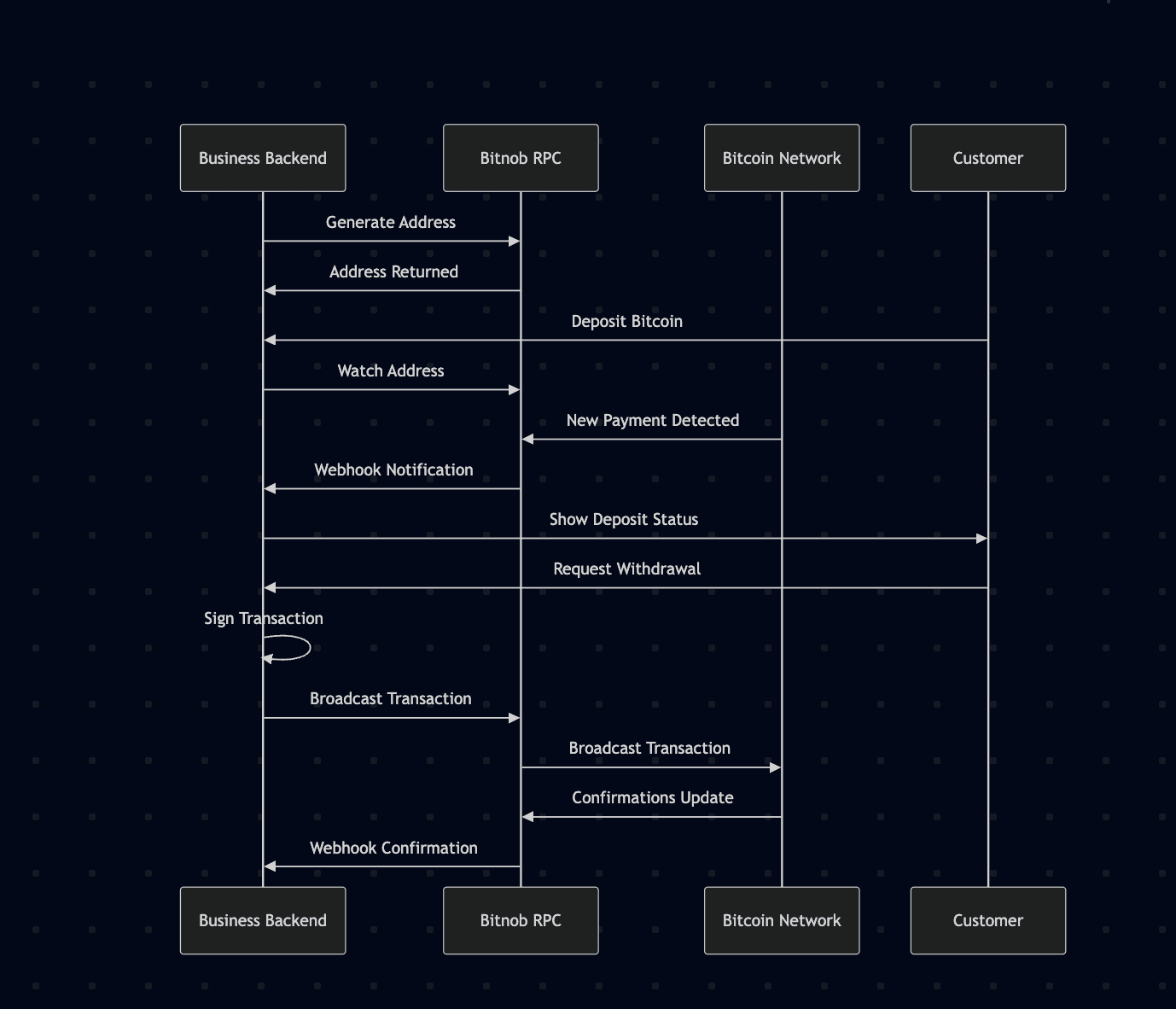
Client App sends a request to the Bitnob API Layer with HMAC-authenticated headers.
Auth & Security verifies credentials and roles.
Depending on the endpoint, the request may route to Wallet Management, the Transactions Engine, or Value-Added Services.
All modules update and retrieve data from the Database & Ledger.
Client App receives a response with transaction details, balances, or confirmation of a completed service.
In the Business-Managed Custody model:
You fully own the custody responsibility.
Bitnob provides you with highly available, highly scalable Bitcoin node access.
You can build any Bitcoin-based financial product without worrying about blockchain ops complexity.