'/%3e%3cdefs%3e%3cpattern%20id='pattern0_2104_4598'%20patternContentUnits='objectBoundingBox'%20width='1'%20height='1'%3e%3cuse%20xlink:href='%23image0_2104_4598'%20transform='matrix(0.00376176%200%200%200.0172414%20-0.00219436%200)'/%3e%3c/pattern%3e%3cimage%20id='image0_2104_4598'%20width='267'%20height='58'%20preserveAspectRatio='none'%20xlink:href='data:image/png;base64,iVBORw0KGgoAAAANSUhEUgAAAQsAAAA6CAMAAACQ2ozcAAAAM1BMVEVMaXH////////////////////////////////////////////////////////////////x7/yuAAAAEHRSTlMAoDDgEPBgwIBAINCwkHBQDIOTDwAAAAlwSFlzAAFxGAABcRgB7MGwCAAABm1JREFUaIHlW+uWsyoMLSIIeH3/pz0CKrmgQuusdn0nf2YaMW42kISgr1cQK+SySj+61/9cmm45RLTfRvNV0WoBIptv4/mi6AWLuiVDd0lKmLPGGPsA0nelGG8TZoXU69poTPi/v1smBjB338dZxvk218B/VIrxBl8hth9t73+Zp2x7SdNuLMX+tJTitZCKjQx1MzFquLBVc+hvpBSv8NMX/Hb+Bv2MbS8DaNsVYn9aSvFK2nWB5slHtr0sUL4Ur0vx+usowdL3A1jBhUVcfGmR1HCBFPbvuWhskvuefC4/wkWbWyMgzV2ub39GarhA+cf0KBevHrTdffSvcuGxonzCA73JBGq4gFnt7qN/lYtxwflEWOA3KWJVriWOpkd0+lUuQj6Rsu6QkcuL9jW2o4xbyzTZfpWLOG79FlatgnP5Y9tRnFn3RAYE7p/loo1bJ6GtnSLIYbuwRrz8rq6SCyY/y8W2UU0SFkw7xQCghszN/y4Xr0ZCKjpPxQz46Vjdj9pupiHUBsxclmRXcOG0CKZHfVV9dHqM1QmRrZNU4IVN15kwQ98fNHSlYNsaUsmmEUw899gNuQCck2ur17KwZXcypM6gsVSCtSN4YcozzLmWqtvbNCPRUDKgbU07RiC/z8XgmOnMtHNiYUJZu8Tbg8YW3B6HOK6PwRPQRo1sT21nBGVq73OxKNaElx8n3iiAR4CL8YbOHlH0YHnXtAL2osg2Gr8PuMgIIaPNTIooqIJdijfkyFO6b6u9gBTDo1M1PKOK6bNcYCBtf9Gwqcc7LHgr1qqFaHil69Y2KAY9zMWe/Ny3BWSU4vVdZ3UtvCHxGuQD7m2nmfY0FyBBGK8bJidXitf/gxbA7DVQwStdBbbVng48zsUxMexdy7EWr/8H9dw/QjJNLRfHKnmci2Pk5G1LW4nX/2U9x5p5eYOLvYj6PBfb+qXHfacWy/H6P6yuhavBfl1Cl0VtK7MaaGcS30wZF6ny2WS4kD71ttjyZgXHEDk5j4Ew2dTh9SbREYCEqA/NBBXY9pHX4E2eLOPiRQT1RsDAv0sc7QZhOHowIwxjHd4wDcDEmCJ1jmjQREG2werBxt3HXKRIwE+cEAYwmMijygze/hxvrq6FNJp0mNp2Zxf0x1ykWD8zLmA7lIChqe+u8U4Eb2goLbjYSaCJdnDqC20jR4JOAMzHXADYjAs4pCj5QYvH3uCFVjy66IR6Y8zoSfDlPr1rhEKdyHCB64GwJ8PHXAA144L3eBcYaw3DixwfW3skqw+GcUpHj1fP60TwSveXXKDRP7fAubjBi2bKwnrAT5p/gAsEEFuA41jNBQ60YZEip8Lq4r/NBexOLRfbvX0XfGZY5i5uVjcNOzs6tz0S23/GhYNctKcWKrmI4Sq+2BlebpRm9FSY8IRYcVTndS3si6DrEX/JBfKdeKjgitcMLw4DxNf7oVcHW/viSLt/kfqV46KHF9BofR5Tr7iA0QKhg6lIJqZe4Q3hExAroJEgIe6c17XgpEOeZy7ighatS7mA0RDlTyiJr8Obr2sJqjmva4H1g7eObREXNEiVcoGeBWqKuXy7FG9kBEhwfyjPZG9wkQOVfJlgS/Bu9+wbyy5z7YoLNL2XfgNMisFTBd6+qH5xW9fqjbV6JLUVfc4FzuS6yVoz3Lyzw7jAi2SlfrWiBTkhaOvwZrnomaa6lrNPxRwX2ft1JRe3Jb40mUvxkmc+Vtcy0NyFjgIv5oJOjEz39nVXitf/Rb6c+4txufQXWTkqpjkuXrnDLlnLhcsfmSU5Up9SvP7ZvK7F4shFXSsrB5lZLrLHXbzGd80FziS4pN15Kd6QXIGJYUhftolyXtfKSgrBWS5c7p6plguyayJyFmcv8IZRT1nmHnKJ5jzvzAoormS5yFoYqrm4AgI//LjFu3cvkKvioLQp2qlIlQseSuEXQYDt7JqFiVmei+wqqeeCfBIFewcT5XK80R+rwZgNx/F60qEhm3Zgu+HHuxK54hMucmTYei5e7B2NCD37hknAy9tDvPS0WjDNef1iTUQMploZvKc942L/3Aj0sXmDi9UOGw0KoQovzAPD2miRhr35mr7fCo3BO0K9pq/ONOBbL03NpIfIcXNQI2gP2gIteym5gSmkGvgbmRd4J/aqj93zFiUc1VCSc+K0WWWytd+HtHZ678YTQ2Yu+4jSzVePbcNVe6n51+U/wZKesx3N5aEAAAAASUVORK5CYII='/%3e%3c/defs%3e%3c/svg%3e)

How Trading Works
A high-level guide to how stablecoin, Bitcoin, and naira (NGN) conversions are priced, executed, and settled within Bitnob’s infrastructure.
What Bitnob Trading Does
Bitnob gives you programmatic access to convert stablecoins, Bitcoin, and Nigerian naira (NGN) using a simple, reliable API. Behind the scenes, it handles:
Price discovery using a routing engine
Quote generation with optional locking
Liquidity sourcing from multiple exchanges and OTC desks
Atomic execution with no partial fills or slippage drift
Wallet settlement with clear status and traceability
As a developer, you only need to make two calls: one to get a quote, one to execute a trade. Everything else including pricing, routing, timing, confirmation, and settlement — is abstracted away.
The Trade Lifecycle
The two calls behind this lifecycle are Quotes and Create Order; the resulting record is read back with Get Order By ID.
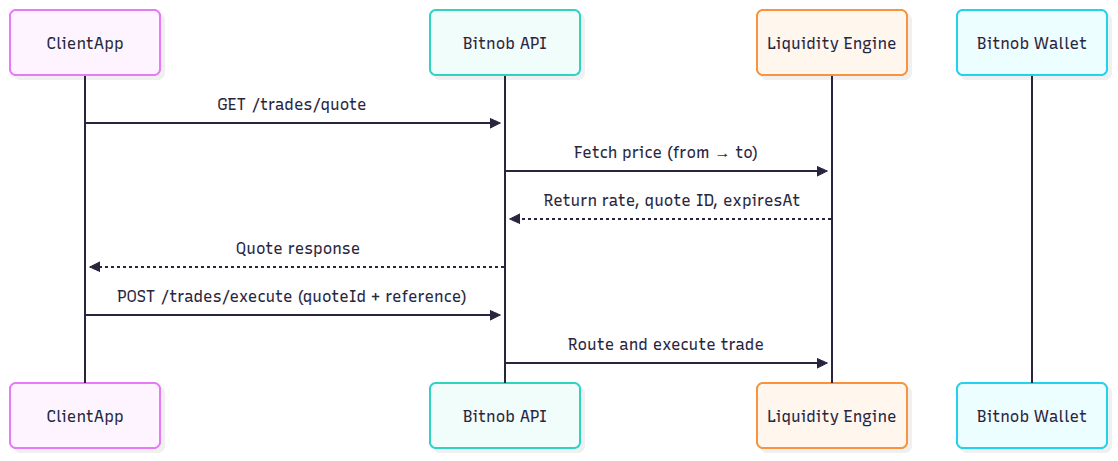
Execution Components
layer | what it does |
|---|---|
Quote Engine | Fetches pricing from internal liquidity pools or external sources |
Routing Logic | Chooses best fill path based on asset, direction, and amount |
Execution Engine | Broadcasts and confirms the trade, ensuring it's atomic and final |
Wallet System | Updates internal balances and credits the user’s destination wallet instantly |
Trade Scenarios
scenario | flow |
|---|---|
User wants to buy BTC with USDT | Quote from USDT → BTC → Execute → BTC is credited to their wallet |
User wants to sell BTC for USDT | Quote from BTC → USDT → Execute → USDT is credited to their wallet |
User wants to swap USDC for USDT | Quote from USDC → USDT → Execute → USDT is credited to their wallet |
User wants to buy USDT with naira | Quote from NGN → USDT → Execute → USDT is credited to their wallet |
User wants to cash out BTC to naira | Quote from BTC → NGN → Execute → NGN is credited to their wallet |
Platform wants to auto-convert | Skip UI, use real-time quote + execute in backend |
Merchant wants to lock price | Fetch quote, hold until its expires_at, show user fixed rate |
Key Properties
Atomicity: Trades either succeed fully or not at all. You won’t see partial fills.
Quote Expiry: Quotes are valid for a short time — about 10 seconds in production; in sandbox, 30 seconds for NGN pairs and about 5 minutes for crypto pairs. If expired, the order is rejected with 422 and "Quote <id> has expired".
Real-Time Settlement: Once the trade is successful, the resulting asset is immediately available in the destination wallet.
No Slippage Guessing: Using quoteId ensures your user receives exactly the output amount shown.
Developer Responsibilities
Store and pass quoteId if you want locked pricing
Always provide a unique reference for traceability
Never rely solely on synchronous responses — use trade.completed webhook for final confirmation
Display rates and expirations clearly in your product interface if exposing trades to users